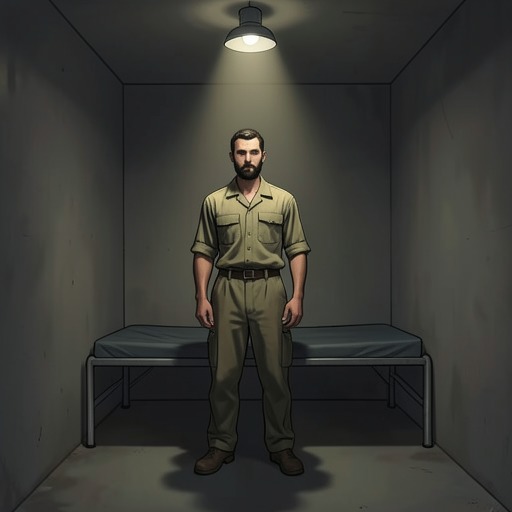
Silverwater Correctional Complex
Crimson LakeSilverwater Correctional Complex is the prison where Ted Conkaffey spent eight months in pretrial custody, a period that shaped both his survival strategies and the disorder of his life after release. The novel presents the institution less through its physical setting than through the rules Ted learns to follow: routine, careful self-management, and the deliberate surrender of personal judgment. The habits that protect him inside become a measure of what he has lost—and what he tries, imperfectly, to recover—outside.
Identity and Narrative Context
Silverwater Correctional Complex enters Ted’s story after his arrest in the case involving Claire Bingley. Before that transition, he endures fourteen hours of questioning by police colleagues and homicide detectives, then spends a night in the cells at his own station. Those cells are not Silverwater: the distinction matters because his movement from a police workplace to a prison marks a sharp change in status, from detective and colleague to a person held under suspicion.
Ted spends eight months at Silverwater. The account identifies the period as imprisonment but does not describe the facility’s location, buildings, or physical layout. Instead, it makes the prison legible through Ted’s account of its procedures and through the people with whom he shared the experience. He recalls being among inmates convicted of serious crimes, yet rejects the idea that criminality can reliably be read from someone’s appearance. That observation also bears on the novel’s wider concern with the gap between public judgment and what can actually be known about a person.
Custody and Legal Uncertainty
Ted’s time in custody is bound to a case that never reaches a straightforward resolution. He is committed to stand trial on charges relating to the rape and attempted murder of Claire Bingley. Halfway through the trial, the Director of Public Prosecutions withdraws the charges, explaining that the available evidence is not strong enough to satisfy a properly instructed jury beyond reasonable doubt. The withdrawal does not amount to an acquittal or a declaration that Ted did not commit the offences; he understands that the case could return if stronger evidence emerged.
That unresolved status gives Silverwater a particular place in his history. Custody does not end with a verdict that settles his name, and release does not restore his former life. Ted no longer works as a police officer, his old friends have not spoken to him, and he wakes each day fearing that he may be arrested again. The prison period is therefore not simply a bounded episode followed by freedom. Its uncertainty continues beyond the institution’s walls, shaping how he understands the future.
Rules as a Survival System
Ted describes survival inside as requiring total physical and emotional submission. The inmate, in this account, follows the routine, reads the orientation handbook, and behaves according to its instructions. He keeps his cell and uniform immaculate, files his papers, and remains courteous and professional in dealings with staff and other inmates. The rules are presented as covering even situations that would ordinarily demand personal judgment, so the inmate can act by procedure rather than decide independently what to do.
The account makes this system concrete through examples. If a fight breaks out, the prescribed response is to get down, place both hands behind the head with fingers interlocked, and wait for instructions. During a routine cell inspection, the inmate stays quiet, follows staff directions, and makes personal belongings available for review. He is also expected to keep current with regulation changes and is accountable under updated behavioural guidelines; not knowing a rule is no excuse. These details show how compliance extends from the everyday organization of possessions to immediate responses under pressure.
Order, Routine, and Institutional Identity
In Ted’s description, organization offers comfort because it reduces the number of decisions an inmate must make. Keeping papers filed, belongings in order, and conduct within the rules becomes a way to remain functional in a setting where personal judgment may invite trouble. The trade-off is a diminished sense of agency: he describes the inmate as a precisely fitted cog in an expanding prison machine, useful because it turns according to the system’s requirements.
That image also defines the danger of resistance. When organization slips, the inmate becomes a grinding cog, producing friction with the institution; Ted observes that some people persist in this opposition, but do not last long. The passage frames compliance not as simple approval of prison authority but as a survival method. Order protects the person who can maintain it, while the system leaves little room for a private standard of conduct that conflicts with its regulations.
After Release and the Prison’s Continuing Effect
A little over two months after his release, Ted recognizes that he has lost the structure that once governed his days. At Crimson Lake township, he has taken up drinking, rented a dilapidated property on the edge of nowhere, and withdrawn from society. He sometimes goes days without showering and sometimes forgets to eat until hunger forces him to notice. Against the ordered inmate life he has described, these habits appear as a collapse of routine rather than an uncomplicated freedom.
His response is to decide to put his belongings away, stop sleeping on a blanket, and begin imposing some structure on himself again. Sitting on the porch in the morning, he uses his phone to find a furniture store in Cairns. He does not order a television because he is afraid of seeing himself. The sequence links a practical attempt to furnish his home with the harder problem of facing his identity after prison. Silverwater’s significance lies in this contrast: inside, rules organize the inmate’s conduct; outside, Ted must attempt to create order for himself while carrying the stigma and uncertainty that custody did not resolve.